
for healthcare professionals
The Science of Early
Allergen Introduction
The Science of Early Allergen Introduction
Clinical evidence summaries, product information, and patient resources to support your conversations about early allergen introduction.
For licensed healthcare professionals only.The information on this page is intended to support clinical conversations. It references findings from peer-reviewed research studies on early allergen introduction — not claims about Amuse specifically. Amuse is a dietary supplement. It is not intended to diagnose, treat, cure, or prevent any disease.
See Amuse in Practice
Food allergy prevalence continues to represent a significant and growing burden on families and health care systems worldwide. Current evidence and international guidelines port early introduction of allergenic foods as a strategy to reduce the risk of IgE mediated food allergies. However, consistent early exposure can be difficult to implement in real world settings, particularly before solid food introduction. Amuse was developed to address this gap. It provides early, controlled exposure to six common food allergens delivered orally in precise, developmentally appropriate amounts. Three daily sublingual drops provide micro doses of allergenic proteins that are designed to support immune tolerance during a critical early window of immune development. Amuse was developed by a board certified pediatric allergist produced in a facility that adheres to good manufacturing practices. Each batch undergoes third party testing to ensure safety, quality, and consistent allergen dosing. By providing a standardized parent friendly routine, Amuse enables guideline aligned care beyond the clinic. Learn more and access provider resources at amusedrops dot com slash providers.
Designed for Everyday Use
Introducing allergenic foods consistently can be challenging for families. Amuse was designed to offer a simple, standardized format for daily exposure to common food allergens during early childhood.
- Takes less than 30 seconds per day
- Shelf-stable after opening
- Travel-friendly packaging
- Designed to integrate into daily routines
- Contains peanut, cashew, walnut, egg, milk and sesame
The Evidence for Early Introduction
Multiple randomized controlled trials have examined early introduction of allergenic foods and their relationship to food allergy outcomes. Below are key findings from published research.
PREVENTADALL (2022)
Lancet · General population · n=2,397
General Population Findings
Infants introduced to allergens at 3 months vs. standard timing
NNT = 63
To prevent one case of food allergy at 36 months in this trial
PREVENTADALL (2022)
Lancet · General population · n=2,397
Timing Effect
Earlier introduction (3–6 months) was associated with better outcomes in per-protocol analysis
3 - 6 months
Window studied in this trial
PREVENTADALL (2022)
Subgroup analysis · Infants with eczema
High-Risk Subgroup Findings
Infants with moderate-severe eczema showed greater risk reduction in this subgroup analysis
NNT = 7–14
For infants with moderate-severe eczema in this trial
Note for providers: All statistics above are findings from the referenced peer-reviewed trials. They describe outcomes observed in study populations and are not claims about the safety, efficacy, or outcomes associated with Amuse. Amuse is a dietary supplement, not a drug or medical treatment.
Landmark Studies in Early Allergen Introduction
Published research findings. These are not claims about Amuse.
Study
Population
Introduction Timing
Published Findings
LEAP (2015)
NEJM · High-risk
High-risk infants (n=640)
4-11 months
81% reduction in peanut allergy development vs. avoidance group in this trial
EAT (2016)
NEJM · General pop.
General population (n=1,303)
3 months
Significant reduction in per-protocol analysis; ITT results limited by adherence challenges
PreventADALL (2022)
Lancet · General pop.
General population (n=2,397)
3 months
Food allergy: 0.9% intervention vs. 2.3% control at 36 months
EarlyNuts (2024)
JACI Pract. · Post-guideline cohort
Post-guideline cohort (n=1,420)
Varied
11.3% prevalence despite widespread early introduction; identified persistent risk factors (early eczema, Asian ancestry, early antibiotic exposure)
What the Research Shows
The following describes biological mechanisms and hypotheses discussed in the published literature on early allergen introduction. This section summarizes research findings — it is not a description of how Amuse works.
The Dual Allergen Exposure Hypothesis
Current research suggests that early oral or mucosal exposure to food proteins may support tolerance development, while skin exposure through a compromised barrier (e.g., eczema) may contribute to sensitization. The timing and route of first exposure may influence immune system development. (Gideon Lack et al., J Allergy Clin Immunol, 2012.)
Biological Mechanisms Under Study
From the peer-reviewed literature on early allergen introduction. These are not claims about Amuse.
Mucosal Route of Exposure
Research has examined the role of the oral mucosal immune environment in early allergen exposure. Oral mucosal tissue contains dendritic cells that may play a role in the body’s response to early food protein contact. The significance of this pathway in dietary supplement delivery is not established.
Regulatory T Cell Response
Studies on early allergen introduction have examined whether consistent early exposure may support the development of allergen-specific regulatory T cells. This represents an area of active research; mechanisms in dietary supplement contexts differ from those studied in clinical immunotherapy trials.
IgG4 vs. IgE Antibody Patterns
Some early introduction research has examined antibody patterns in study participants, including the relative prevalence of blocking antibodies (IgG4) vs. allergy-associated IgE antibodies. These findings are from clinical trial contexts and cannot be generalized to dietary supplement outcomes.
Duration of Exposure in Research
AAAAI/ACAAI 2024 consensus guidance indicates that research data suggest 2–3 years of consistent allergen exposure may be associated with higher probability of sustained immune response. This reflects current interpretation of trial data and informs clinical practice guidance — not a product recommendation from Amuse.
About Amuse
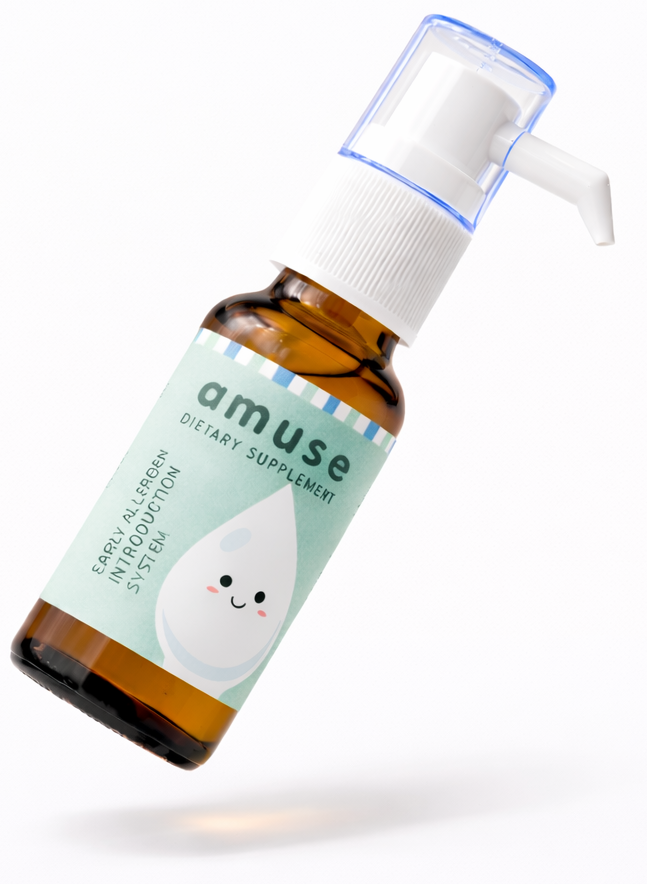
A dietary supplement providing consistent, measured exposure to six common allergenic proteins.*

Precise Microdosing
Each 0.14mL dose (3 pumps) delivers consistent microdoses of all six allergens in a single daily administration

Early Start Option
Designed for introduction as early as 2 months of age, aligned with the introduction windows studied in landmark clinical trials

Simple Daily Routine
3 pumps daily, oral administration — designed to support consistent daily use, which trial data indicates matters for outcomes

Six Common Allergens
Cow’s milk, egg, peanut, cashew, walnut, and sesame — the major allergens studied in early introduction research

Quality Assurance
Third-party tested for allergen content consistency and purity. Manufactured in a cGMP-compliant dietary supplement facility.

Allergist-Developed
Created by Dr. Brynn Everist, Mayo Clinic-trained allergist and immunologist with expertise in early allergen introduction
Regulatory Status
Amuse is classified as a dietary supplement under 21 CFR Part 111. It does not require FDA approval and has not been evaluated by the FDA for safety or efficacy. As a dietary supplement, it is not intended to diagnose, treat, cure, or prevent any disease.
Amuse is available direct-to-consumer without a prescription. It is designed to complement — not replace — whole food introduction per AAP feeding guidelines. Providers should exercise their clinical judgment when discussing this product with families.
Suggested Use & Safety Considerations
The following reflects suggested product use informed by published early allergen introduction research. Providers should use their clinical judgment for individual patients.
Patient Selection
Potentially Appropriate For
Healthy infants from general population (consistent with AAAAI/ACAAI 2024 early introduction guidance)
Infants with mild-to-moderate eczema where allergen introduction is being considered
First-degree relative with food allergy — discuss with provider
Families seeking a consistent daily format for allergen introduction
Situations where whole food introduction adherence is challenging

Consult An Allergist First
Amuse is not intended for use in the following situations without recommendation from an allergist
Diagnosed or suspected IgE-mediated food allergy to any ingredient
History of anaphylaxis to any food
Acute systemic illness or significantly compromised immune system
Known or suspected FPIES or non-IgE-mediated food protein reactions
Moderate-severe eczema with early onset (before 6 months) — may have existing sensitization
When to refer to an allergist
For infants with moderate-severe eczema with active flares, history of immediate reaction to any food, or known or suspected FPIES, consultation with an allergist is appropriate before initiating any allergen introduction approach — including dietary supplements.
Suggested Use Guidance
Note: The following is suggested product use informed by published trial findings and current AAAAI/ACAAI guidance. It is not a clinical protocol or a medical recommendation from Amuse. Providers should exercise their independent clinical judgment for individual patients.
1
Timing of Introduction
Introduce between 2–6 months of age, after initial breastfeeding is established. Based on PreventADALL data, earlier introduction within this window was associated with better outcomes in that trial.
2
Standard Dosing
3 pumps (0.14mL) administered orally once daily. Consistent daily use is designed to support regular exposure, which early introduction research suggests is important for outcomes.
3
Duration of Use
Current AAAAI/ACAAI 2024 guidance indicates that trial data suggest 2–3 years of consistent exposure may be associated with higher likelihood of sustained response. Providers should use clinical judgment on appropriate duration for individual patients.
4
First Dose Considerations
For higher-risk infants (moderate-severe eczema), clinical supervision of first introduction may be appropriate. Most infants from the general population can begin at home per AAP and AAAAI/ACAAI guidance.
5
Integration with Whole Foods
Amuse is designed to complement — not replace — whole food introduction per AAP feeding guidelines. Whole foods provide nutrition and feeding skill development; Amuse provides a consistent daily format for allergen exposure.
6
Monitoring & Follow Up
Advise families to watch for signs of allergic reaction during first introduction and to seek immediate care if concerned. Routine follow-up per standard well-child schedule is appropriate for most infants. Providers may consider earlier follow-up for infants with moderate-severe eczema.
Patient Communication
Resources
Downloadable materials to support conversations with families
about early allergen introduction.
Patient Communication Resources
Downloadable materials to support conversations with families
about early allergen introduction.
Clinical Overview
Comprehensive summary of the early introduction evidence base, product specs, and suggested use for HCPs
Sample Request Form
Request complimentary samples to evaluate in your practice before recommending to patients
Dosing Instruction Card
Visual guide with step-by-step instructions for administering Amuse oral drops to infants
Frequently Asked Questions
Common questions from healthcare providers about Amuse and early allergen introduction.
How does Amuse differ from whole food introduction?
Amuse is designed to complement whole food introduction, not replace it. The two serve different purposes: whole foods develop feeding skills and provide nutrition, while Amuse provides early, consistent immune exposure ⚑ via a sublingual format that can begin as early as 2 months. The clinical case for Amuse is largely an adherence argument — the EAT trial showed that many families assigned to early introduction failed to maintain the required frequency and quantity of multiple allergens simultaneously. A format with a fixed daily dose removes the preparation and decision burden that drives non-adherence. It’s also the only format that enables multi-allergen exposure this early, before solid foods are developmentally appropriate.
What does the evidence say about dosing amounts?
Clinical trials used a range of exposure protocols, and the evidence consistently points to early timing and regularity as the primary drivers of benefit — more than any specific dose threshold. PreventADALL demonstrated meaningful reduction in food allergy risk with food introduction beginning around 3 months, and the EAT trial found that infants who maintained regular exposure — even at lower-than-protocol levels — showed benefit. Amuse’s formulation provides consistent microdose exposure across 11 allergens in a measured daily format ⚑ sublingually, designed to support the regular mucosal immune contact that underlies tolerance development.
Can Amuse be used while breastfeeding?
Yes — Amuse is designed to be used alongside breastfeeding, and leading trials (PreventADALL, EAT) showed no adverse effect on breastfeeding continuation when allergenic food introduction began as early as 3 months. Breast milk exposure to allergens via maternal diet is normal and does not preclude early introduction. Amuse can be initiated while an infant is exclusively breastfed; there is no need to wait for solid food readiness. This aligns with current AAAAI/ACAAI guidance that early introduction should not be delayed pending breastfeeding cessation.
What about infants with eczema?
Infants with eczema — particularly moderate-to-severe eczema with onset before 6 months — are among the highest-risk group for food allergy development and represent a key population for early introduction. Major trials including PreventADALL enrolled infants with eczema and found early introduction beneficial in this group. For mild eczema with no prior allergic reactions, standard introduction protocols apply. For moderate-to-severe eczema, especially with early onset or a history of any immediate food reaction, we recommend allergist consultation before initiating Amuse, as these infants have elevated probability of existing sensitization. Amuse is not intended for use in infants with confirmed IgE-mediated allergy without specialist guidance.
How long should use continue?
AAAAI/ACAAI guidance and supporting trial data suggest that consistent early allergen exposure through at least the first year of life, and ideally into the second or third year, is associated with the strongest probability of sustained tolerance. Amuse is formulated to support daily use through this window. For most families, we’d suggest framing continued use as analogous to a daily supplement — low burden, high consistency. Whole food introduction should continue in parallel and take over as the primary allergen exposure mechanism as the child’s diet diversifies.
Is this FDA approved? What's the regulatory status?
Amuse is a dietary supplement and is not subject to FDA pre-market approval. It is manufactured to dietary supplement cGMP standards and undergoes third-party testing for allergen content consistency and quality. As a dietary supplement, Amuse is intended to support immune system development through early allergen exposure — it is not intended to diagnose, treat, cure, or prevent any disease. When families ask, we suggest framing it similarly to how you’d frame a vitamin D or probiotic supplement: evidence-supported, not a pharmaceutical, and appropriate to use without a prescription under your guidance.
Can families obtain this without a prescription?
Amuse is available direct-to-consumer at amusedrops.com without a prescription. However, a provider recommendation meaningfully increases the likelihood that families start at the right time, use the product correctly, and know when to pause and call. We’ve found that families who hear about Amuse from a trusted clinician are more likely to use it consistently — which is where the benefit comes from. For higher-risk infants (moderate-severe eczema, family history of food allergy), a brief conversation about candidacy and first-dose monitoring can make the difference between a positive experience and an unnecessary scare.
What safety monitoring is recommended?
For most infants in the general population, standard well-child visit follow-up is sufficient. Counsel families before first use to observe the infant for 30 minutes after initial administration and to contact your office if they notice hives, facial swelling, vomiting, or unusual irritability. Serious adverse events were rare across major trials; the most common reactions were mild GI symptoms or skin flushing. For infants with moderate-to-severe eczema, consider scheduling a brief check-in call or visit after the first week of use. Families should be reminded that Amuse is not appropriate for use during acute illness or active eczema flares, and that the product should be paused and your office contacted if any allergic symptoms occur.
What about the EarlyNuts finding that food allergy remained high despite widespread early introduction?
EarlyNuts 2024 found that despite broad public health messaging around early introduction, food allergy rates remained elevated — particularly among infants with Asian ancestry, early-onset eczema, or early antibiotic exposure. This is an important nuance: early introduction reduces risk but is not universally preventive, and some subpopulations may need more targeted approaches. The study also found that a significant proportion of families did not successfully introduce peanut by 6 months despite guidelines, highlighting that adherence is a genuine clinical barrier. Amuse is designed to address the adherence side of this equation — consistent, measured daily exposure may reduce the gap between guideline intent and real-world behavior.
Key Scientific References
1. Skjerven HO, Lie A, Vettukattil R, et al. Early food intervention and skin emollients to prevent food allergy in young children (PreventADALL): a factorial, multicentre, cluster-randomised trial. Lancet. 2022;399:2398-2411.
2. Soriano VX, Allen KJ, Dharmage SC, et al. Prevalence and Determinants of Food Allergy in the Era of Early Allergen Introduction: the EarlyNuts Population-Based Study. J Allergy Clin Immunol Pract. 2024 [In Press].
3. Du Toit G, Roberts G, Sayre PH, et al. Randomized trial of peanut consumption in infants at risk for peanut allergy. N Engl J Med.2015;372:803-813.
4. Perkin MR, Logan K, Tseng A, et al. Randomized trial of introduction of allergenic foods in breast-fed infants. N Engl J Med.2016;374:1733-1743.
5. Iglesia EG, Ansotegui IJ, Azuaga S, et al. Health Promotion of Early and Sustained Allergenic Food Introduction for the Prevention of Food Allergy. J Allergy Clin Immunol In Practice. 2024;12(7).
6. Fleischer DM, Chan ES, Venter C, et al. A consensus approach to the primary prevention of food allergy through nutrition: guidance from the American Academy of Allergy, Asthma, and Immunology; American College of Allergy, Asthma, and Immunology; and the Canadian Society for Allergy and Clinical Immunology. J Allergy Clin Immunol Pract. 2021;9:22-43.
Questions about Amuse?
Our medical team is here to support your practice
Important Information for Healthcare Professionals
*These statements have not been evaluated by the Food and Drug Administration. This product is not intended to diagnose, treat, cure, or prevent any disease.
The information provided on this page is for educational purposes and represents findings from peer-reviewed research studies on early allergen introduction. Healthcare providers should use their clinical judgment when making recommendations. The clinical studies referenced investigated early introduction of allergenic foods; outcomes described are from these published studies and are not claims about Amuse specifically. Amuse is a dietary supplement designed to support immune system development through early exposure to food allergens.
This page is intended for licensed healthcare providers only. For complete product information, dosing guidelines, and safety considerations, please refer to the full Clinical Overview or contact our Medical Affairs team.