
When to Introduce Allergens to Your Baby: Complete 2026 Guide

Why timing matters more than you think
If you’ve ever been told to wait on allergens — wait until six months, wait until a year, wait until your baby is “ready” — I want you to know something: that advice is outdated. And it has consequences.
I’m a board-certified pediatric allergist. I see the results of delayed introduction in my practice every day. And what the research has made clear over the past decade is that the immune system doesn’t wait. It’s learning from the very beginning — and the question isn’t whether to introduce allergens. It’s when and how.
The answer, for most babies, is earlier than most parents expect.
📊 What the research shows
The LEAP study found that infants introduced to peanut early had an 81% lower rate of peanut allergy compared to those who avoided it (Du Toit et al., NEJM 2015). A 2024 follow-up — LEAP-Trio — found that protection persisted at age 12, with a 71% reduction in peanut allergy even years after children stopped regular peanut consumption.
That’s not a small effect. And peanut is just one allergen. The EAT study showed that introducing multiple allergens — including egg, milk, sesame, and tree nuts — early in infancy was both safe and feasible (Perkin et al., NEJM 2016).
So what does “early” actually mean, month by month? That’s what this guide is for.
The two timelines parents miss
Here’s where a lot of the confusion comes from. There are actually two different timelines at play when it comes to allergens and infants — and they don’t line up the way most parents assume.
Timeline 1: Developmental readiness for solid foods. Most babies are ready to begin solid foods around 4 to 6 months of age. Before then, they have limited trunk control, a strong extrusion reflex that pushes food back out, and no reliable ability to move food safely in their mouths. You can’t just hand a 2-month-old a spoonful of peanut butter.
Timeline 2: Immune readiness for allergen exposure. The immune system is active and learning well before a baby takes a first bite of solid food. The window for immune learning — the period when early exposure does the most protective work — opens in early infancy and doesn’t wait for the solid foods milestone.
✅ The gap that matters
The most important thing to understand: developmental readiness and immune readiness are on different schedules. Your baby may not be ready to eat solid food at 2 months — but their immune system is already learning. That gap is why early allergen exposure, in forms appropriate for early infancy, matters so much.
Understanding these two timelines changes how you think about allergen introduction entirely. It’s not one event. It’s an ongoing process — and the earlier it starts, the better the immune system can learn what is safe.
Month-by-month timeline: allergen introduction from birth to one year
Here’s how allergen introduction looks across your baby’s first year, based on current clinical evidence and guidelines from AAAAI/ACAAI, NIAID, and the AAP.
Protein exposure is possible — and beneficial
Your baby isn’t ready for solid food. Nutritionally, breast milk or formula is everything they need. But their immune system is already active and responsive to food proteins.
Research supports introducing allergenic food proteins in forms safe for this age — very small amounts that work with the immune system’s early learning, not against developmental readiness. Up to 20% of babies who will develop food allergy are already sensitized by 4 months of age. The window is open now.
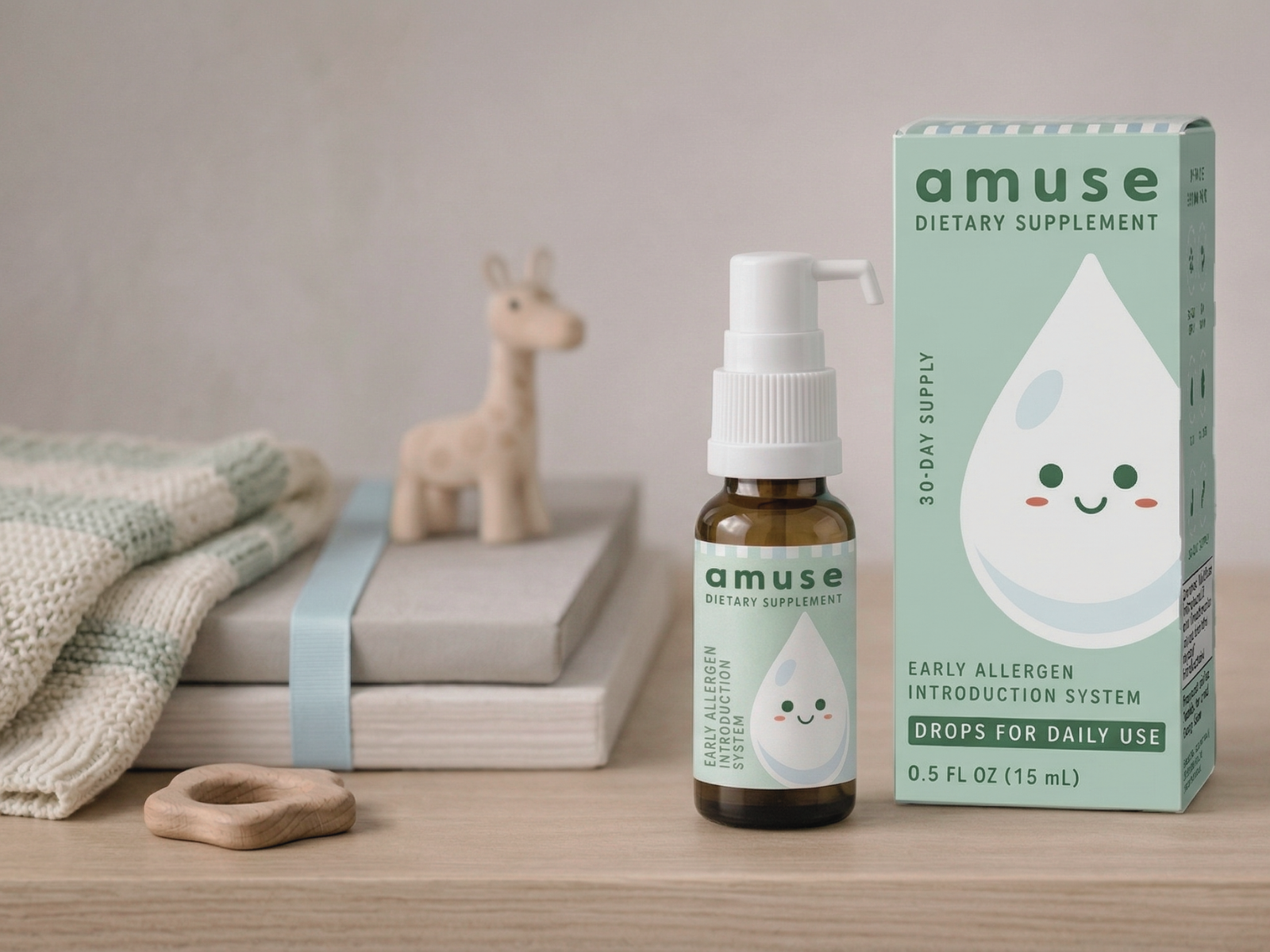
What this looks like: Breast milk exposure via maternal diet. Very small protein exposures in appropriate forms (not solid food). This is precisely why Amuse was designed — a way to introduce allergenic proteins as early as 2 months, before solid foods are appropriate.
Consistency starts to do its work
The extrusion reflex is still strong — solid food will largely be pushed back out. Your baby is gaining trunk control but isn’t ready for a high chair or independent feeding.
What matters at this stage is frequency, not quantity. A study from Australia found that early peanut and egg introduction starting at 3 months reduced food allergy development — and that the frequency of exposure mattered more than the dose. Small amounts given consistently had real protective effects.
What this looks like: Continue daily protein exposure in appropriate forms. No solid food yet. Breast milk remains the primary nutrition source.
The first tastes of real food — and allergens
Some babies begin showing readiness signals around 4 months: leaning toward food, opening their mouth when they see eating, beginning to track food with their eyes. The extrusion reflex starts to fade. This is when some solid food introduction can begin — and when allergenic foods should be introduced intentionally.
Current NIAID guidelines recommend that high-risk infants (those with severe eczema or egg allergy) begin peanut introduction between 4 and 6 months. For most other infants, introduction at this stage or earlier is appropriate.
What this looks like: Thin peanut butter mixed into puree, soft scrambled egg, yogurt. Small lick-sized amounts. Family mealtime involvement. Continue daily protein exposure in supplement form as an insurance policy for the days when real food isn’t possible.
Build variety, maintain consistency
By 6 months, most babies are developmentally ready for solid foods. They can sit with support, have reasonable head and trunk control, and are genuinely curious about what the family is eating. Breast milk or formula remains the primary nutritional source — solids at this stage are still primarily about exposure and learning, not caloric intake.
The goal now is to continue regular exposure across all major allergens. Don’t introduce one allergen and stop. The protective effect of early introduction depends on consistent, ongoing exposure — not a single introduction event.
What this looks like: Varied allergen foods at most meals. Peanut, egg, dairy, tree nuts, sesame in appropriate textures. Daily supplemental exposure for any allergens not consistently present in the food routine.
Keep going — the routine is the goal
By this stage, your baby has more motor control, more variety in what they eat, and more participation in family meals. Allergen introduction through food is increasingly practical. But the research is clear on one thing: stopping regular exposure doesn’t lock in protection.
The protective effect requires ongoing exposure. If allergens are introduced early and then disappear from the diet, sensitization can still develop. The goal throughout the first year — and beyond — is building a reliable, consistent routine that keeps exposure steady.
What this looks like: Allergens present across the weekly meal rotation. Continue supplemental exposure for any allergen not consistently present in food. Discuss with your pediatrician at each well visit.
Which allergens should you introduce?
The nine major allergens — peanut, tree nuts, milk, egg, wheat, soy, sesame, fish, and shellfish — account for the majority of food allergic reactions in children. Of these, the ones with the strongest early-introduction evidence are peanut, egg, and milk.
Tree nuts deserve attention too. About 40% of food-allergic children have more than one food allergy (Gupta et al., Pediatrics 2018). Introducing multiple allergens — not just peanut — from early infancy addresses the real-world pattern of food allergy, which rarely occurs in isolation.
🥜 The allergen introduction order at Amuse
Amuse introduces six of the most common food allergens: peanut, walnut, cashew, milk, egg, and sesame. This order reflects both clinical prevalence and the dosing card included with every order. Sesame became a major US allergen requiring labeling in 2023, and about 17% of food-allergic children also have sesame allergy (Warren et al., JAMA Network Open 2019).
A practical note: you don’t need to introduce every allergen in a single week, or on a rigid schedule. What matters is that exposure is early (before the immune window closes) and consistent (repeated regularly, not a one-time event).
What if my baby has eczema?
This is one of the most common questions I get — and one of the most important to answer correctly.
If you were told to wait on allergens because your baby has eczema, that guidance is outdated. The LEAP study was specifically designed for high-risk infants — babies with severe eczema, egg allergy, or both. It found that earlier introduction was especially important for this group, not a reason to wait.
Eczema is a sign that the immune system is already primed toward allergic responses. Introducing allergens early, before sensitization has a chance to develop, is particularly valuable for these babies. Waiting increases the window of risk, not decreases it.
⚠️ Important exception
Some babies with very severe eczema, or babies already suspected to have a food allergy, may benefit from evaluation by an allergist before introduction. This is not most babies with eczema — it applies to the most severe cases. If you’re unsure which category your baby falls into, ask your pediatrician.
For the large majority of babies with eczema: introduce allergens early and consistently. Don’t wait.
What about family history of food allergy?
Another very common concern — and another case where the right answer might surprise you.
A specific food allergy does not run in families. The tendency to develop allergy does run in families — but that tendency does not predict which food your baby will be allergic to, and it is not a reason to avoid introducing a particular allergen. In fact, a family history of food allergy is reason to be more intentional about early introduction, not less.
If your child’s sibling has a peanut allergy, your pediatrician may recommend an allergist consult before introducing peanut. But avoiding peanut entirely is not the protective strategy it was once thought to be. Early, consistent introduction — beginning sooner rather than later — is.
Why consistency is the real goal
I want to come back to something, because I think it’s the most important practical insight from all of this research: it’s not about a single perfect introduction. It’s about consistency over time.
Studies on early allergen introduction consistently show that frequency matters more than dose. Small amounts, given regularly, support immune learning. Large amounts given once do not.
This has real implications for how you approach allergen introduction at home. You don’t need to feed your baby peanut butter every single day through solid food alone. What you need is reliable, daily exposure — in whatever form makes that sustainable for your family.
I built Amuse because I couldn’t figure out how any parent was supposed to remember to give their baby peanut, walnut, cashew, milk, egg, and sesame every day — especially before solid foods were even part of the routine. Three drops, once a day, is something you can actually do. That’s the point.
The core principle
Small and consistent — that’s what the research supports. Not perfect. Not complicated. Just regular, early exposure that fits into real family life.
Where Amuse fits in
Amuse was designed to solve a specific problem: how do you get consistent, daily allergen exposure to a baby who isn’t ready for solid food yet?
The answer is early allergen introduction in drop form — small, measured amounts of six allergenic food proteins, designed to fit into everyday routines starting from 2 months of age. It works alongside solid food introduction as your baby grows, not instead of it.
It’s particularly useful for families who:
- want to start before their baby is ready for solids
- are introducing allergens through food but want a consistent baseline of daily exposure
- find it hard to keep every allergen present in the weekly food rotation
You can learn more about how Amuse works here:
→ amusedrops.com/pages/amuse-drops
And for a deeper look at the research behind early introduction:
→ amusedrops.com/science
Common questions parents ask
The bottom line
If there’s one thing I want you to take away from this guide, it’s that timing matters — and earlier is better. Not because waiting is dangerous, but because the immune system is most actively learning in early infancy, and every week of consistent exposure during that window counts.
You don’t need to do it perfectly. You don’t need large amounts. You don’t need a complicated plan. You need a simple, consistent routine that starts as early as possible and keeps going.
One in thirteen children in the United States has a food allergy (Gupta et al., Pediatrics 2018). Peanut allergy alone affects about 2% of children — and only about 20% of those children will ever outgrow it. These are largely permanent diagnoses. They affect how children eat at school, at parties, at friends’ houses, for the rest of their lives.
We now have strong, replicable evidence that early introduction can meaningfully change that outcome. The research is there. The guidance is there. The question is just whether parents have the practical tools to act on it — starting early, staying consistent, and fitting it into the real, busy, beautiful chaos of life with a baby.
That’s what Amuse is for.

About the Author
Dr. Brynn Everist, MD • Board-Certified Allergist & Immunologist
Dr. Everist is a Mayo Clinic-trained allergist specializing in pediatric food allergies and sublingual immunotherapy. As the founder of Amuse, she combines clinical expertise with lived experience as a mother of three to make early allergen introduction accessible to all families.
Tags:
Published:
|
Last Updated:
- May 6, 2026
|
Medical Review By:
Dr. Brynn Everist, MD
Keep reading
Ready to Start Early Introduction?
starting as early as 2 months.