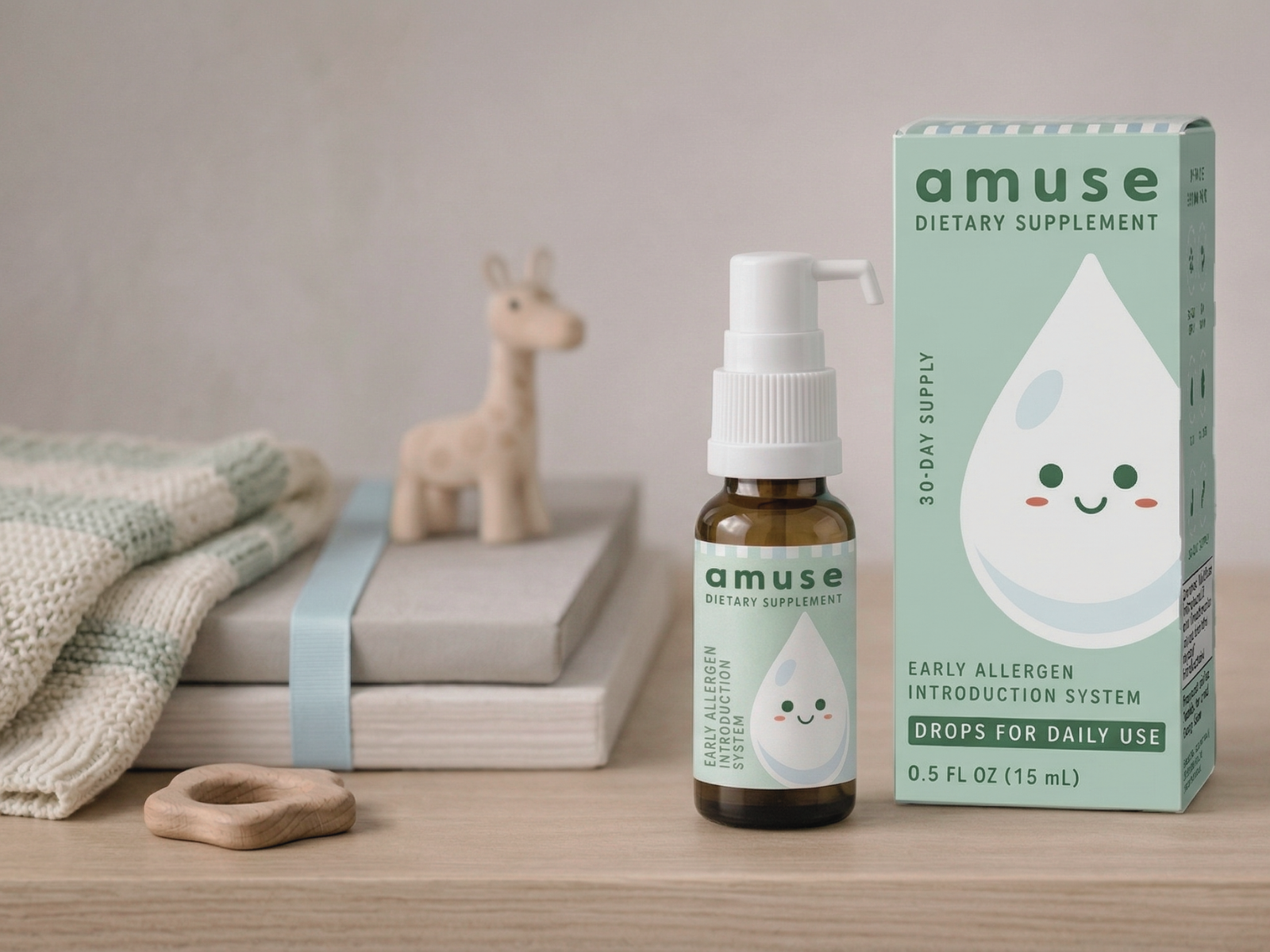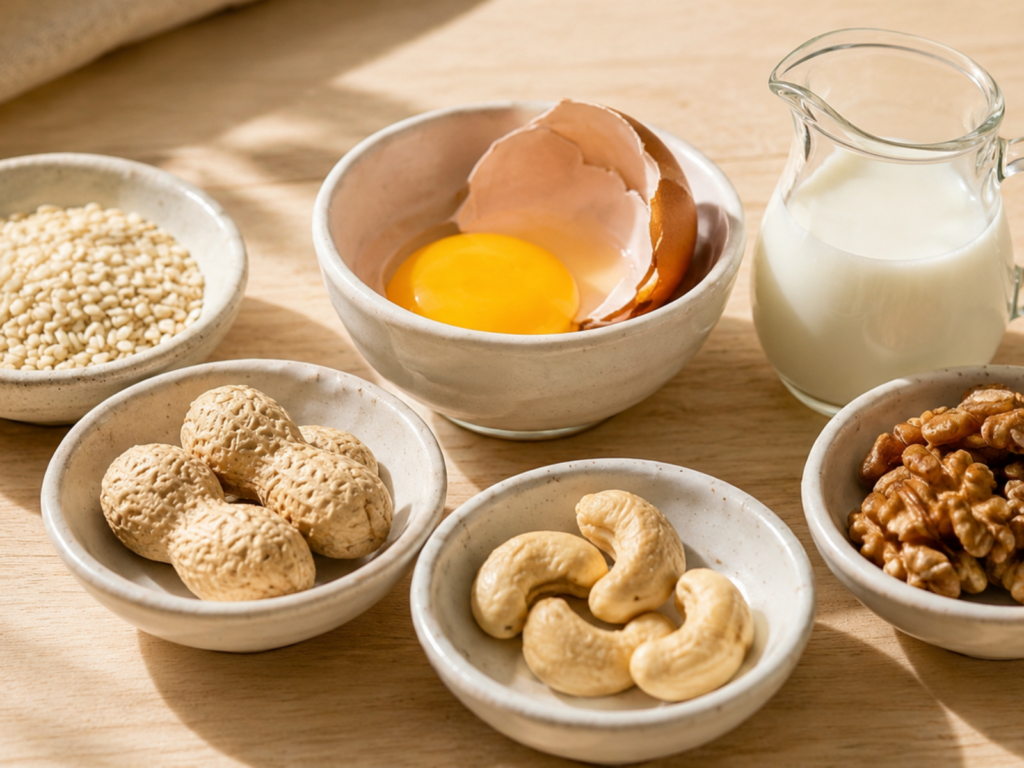
When parents look at the Amuse formula — peanut, walnut, cashew, milk, egg, and sesame — the natural question is: why these six? The answer has two parts. The first is that these are the most common food allergens in early childhood, accounting for the vast majority of allergic reactions in infants and toddlers. The second part is less obvious, and it matters: because of how proteins are shared across botanical families, introducing these six foods actually exposes your baby to the protein families behind a much wider group of allergens.
This is the science of cross-reactivity. And understanding it makes the case for Amuse’s formula even stronger than the ingredient list suggests.
What is cross-reactivity, and why does it matter?
Cross-reactivity happens when proteins from two different foods are structurally similar enough that the immune system responds to both. This is determined largely by botanical family — cashew and pistachio, for instance, are both members of the Anacardiaceae family and share several of the same protein structures. Walnut and pecan are both Juglandaceae. The immune system doesn’t distinguish between brands; it distinguishes between protein shapes.
For parents thinking about early allergen introduction, this matters in two ways. First, it explains why certain food allergies so commonly appear together — a child allergic to cashew is very likely also reactive to pistachio, not because they encountered pistachio separately, but because the underlying proteins are nearly identical. Second, it means that early exposure to one food in a protein family may also support the immune system’s familiarity with related proteins in that same family.
💡 An important distinction
Cross-reactivity refers to shared protein structures between foods. It does not mean that introducing one food guarantees a specific outcome for another. What the research shows is that the protein families behind many tree nut allergies overlap significantly — and that Amuse’s formula covers the most clinically important of those families.
The strongest cross-reactive pairings in tree nuts
Research has identified clear patterns in which tree nuts share the highest degree of protein overlap. Two pairs stand out above all others.
Cashew ↔ Pistachio
Cashew and pistachio belong to the same botanical family (Anacardiaceae) and share highly similar protein structures, particularly 2S albumins and vicilins. Studies have documented co-allergy rates between 64 and 100% — in one study, every pistachio-allergic patient was also cashew-allergic. The AAAAI Food Allergy Practice Parameter recommends that patients allergic to cashew avoid pistachio as a clinical standard. Amuse includes cashew. By introducing cashew’s protein family early, your baby is also being exposed to the same proteins that define pistachio allergy.
Walnut ↔ Pecan
Walnut and pecan are members of the Juglandaceae family and show similarly strong co-reactivity. Research from the NUT CRACKER study found that two-thirds of walnut-allergic patients were also pecan-allergic — and that every pecan-allergic patient in the study was also reactive to walnut. Like cashew and pistachio, the AAAAI guidelines recommend avoiding pecan in walnut-allergic patients. Amuse includes walnut, which means daily exposure to the Juglandaceae protein family shared with pecan.
The broader hazelnut cluster
Beyond the two primary pairs, the Pronuts study — a multicenter European oral food challenge study — identified a broader cluster of cross-reactive tree nuts: walnut, pecan, hazelnut, and macadamia. Hazelnut also bridges a second overlapping group that includes cashew, Brazil nut, pistachio, and almond. While clinical reactivity within these broader clusters is more variable than within the primary pairs (over 50% of patients sensitized to 5–6 tree nuts were clinically allergic to only 1–2), the protein family overlap is meaningful. Walnut and cashew together span much of this broader network.
NUT CRACKER Study (2018) — Co-Reactivity Across Tree Nuts
Elizur et al. studied nut co-reactivity in a pediatric cohort and found the cashew/pistachio and walnut/pecan pairs to be the most clinically consistent. The study also underscored the gap between sensitization and true clinical allergy — a finding that supports the value of early introduction rather than avoidance.
How Amuse’s formula maps to the research
The six allergens in Amuse were not chosen arbitrarily. They reflect both the most clinically prevalent food allergens in childhood and the most important protein family anchors in the cross-reactivity literature. Here’s how the formula maps to what the science shows.
| Amuse Ingredient | Botanical Family | Cross-Reactive Partner(s) | Clinical Note |
|---|---|---|---|
| Peanut | Fabaceae (legume) | Tree nuts (partial), sesame (via 2S albumin) | 25–50% of peanut-allergic patients are co-allergic to at least one tree nut; 81% allergy reduction with early introduction (LEAP, 2015) |
| Walnut | Juglandaceae | Pecan (strong); hazelnut, macadamia (moderate) | All pecan-allergic patients in NUT CRACKER were also walnut-allergic (2018) |
| Cashew | Anacardiaceae | Pistachio (strong); hazelnut, Brazil nut, almond (moderate) | 64–100% co-allergy rate with pistachio across studies (NUT CRACKER 2018; Pronuts 2020) |
| Milk | — | Other mammalian milks (limited overlap) | One of the most prevalent infant food allergies; most children outgrow by school age |
| Egg | — | Other egg proteins (chicken, duck — limited clinical relevance in infancy) | Among most common early allergens; strong evidence base for early introduction (EAT study, 2016) |
| Sesame | Pedaliaceae | Peanut and tree nuts (via shared 2S albumin); 60.7% co-allergy with peanut/tree nut in Pronuts | Now a major allergen in the U.S.; cross-reactivity with peanut via 2S albumin protein family (Dreskin et al., 2021) |
Taken together, Amuse’s two tree nuts — walnut and cashew — represent the protein anchors for the five most clinically significant tree nut allergens: walnut, pecan, cashew, pistachio, and a meaningful portion of the hazelnut protein profile. Peanut and sesame share overlapping protein families via the 2S albumin structure, meaning their inclusion together is not incidental. And milk and egg round out the formula with the two most prevalent early-childhood allergens, both of which have strong clinical trial support for early introduction.
What this means for your baby’s early introduction routine
The practical implication here is straightforward. When your baby receives three drops of Amuse each day, they are not being introduced to six isolated foods. They are being introduced to the protein families that underlie the most common food allergies in childhood — including several that are not explicitly listed on the label.
This does not mean Amuse introduces every possible allergen, or that it guarantees a specific outcome for any individual food. The science of cross-reactivity is probabilistic, not deterministic. What it does mean is that the formula was built with this broader protein landscape in mind — and that consistent daily exposure to these six ingredients is a more comprehensive starting point than six individual foods might suggest.
💡 What current guidance recommends
NIAID guidance (Togias et al., 2017) and updated AAAAI/ACAAI recommendations support introducing common allergens early — around 4–6 months, and as early as 2 months for protein exposure via oral drops. The guidance emphasizes frequency and consistency of exposure over any single large dose. Amuse is designed around that principle: small amounts, daily, starting early.
EAT Study (2016) — Enquiring About Tolerance
Perkin et al. demonstrated that introducing six allergens — including peanut, egg, milk, and sesame — from as early as 3 months of age was safe and feasible in breastfed infants. The EAT study provided foundational evidence that multi-allergen early introduction does not increase risk, and that the protein families Amuse covers can be introduced together without concern.
Common questions parents ask
Bottom Line
Amuse introduces six allergens. But because of how proteins are shared across botanical families, those six ingredients cover the protein landscape behind a much broader set of common food allergens — including pistachio, pecan, and key portions of the hazelnut and sesame protein families. The formula was designed with this breadth in mind. Consistent daily exposure to these six ingredients is a more comprehensive starting point for early allergen introduction than the ingredient list alone suggests.